Disney’s latest short film Versa is about pregnancy loss — and it’s resonating with viewers.
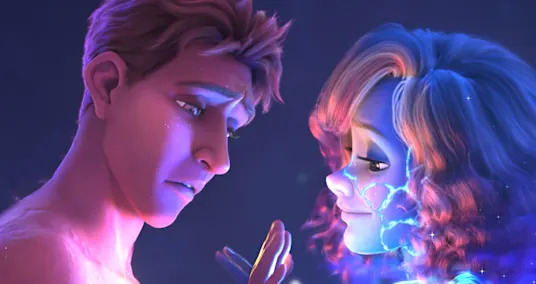
The roughly nine-minute film, written and directed by Malcon Pierce and now available on Disney+, uses music and animated dance sequences to tell the story of two celestial beings excited to become parents. However, when they lose the pregnancy — depicted as a blue starlight inside the mother — the two begin a grieving process that initially separates them. By the end of the film, the beings come back together to heal and develop starlight scars on their bodies, marking what they have endured.
In an introduction of the film before it begins on Disney+, Pierce explained that the movie was inspired by his and his wife’s experience losing their son, Cooper, who died the day he was born. While he and his wife initially approached their grief in different ways, Pierce said that he eventually realized how empowering it was to open up about the loss rather than try to avoid it — thus inspiring Versa.
Pierce’s story has resonated with others who have experienced similar struggles. On an Instagram post announcing the film’s Disney+ release, viewers applauded the short for tackling difficult subject matter, with many calling it “beautiful” for its interpretation of grief.
“We just found out three days ago we lost our little one,” one person commented. “We watched the opening of Up yesterday and then just watched Versa tonight without even knowing what it was about. Versa made us both feel so seen and we were able to cry together and just take in everything we had just gone through.”
They thanked the animation team, writing that the film “means more than you’ll ever know.”
Another wrote, “As someone who has experienced pregnancy loss this was so moving and such a great expression of what couples go through. Thank you for sharing your story.” A third noted that they hope the children they lost are “still traveling through stardust,” calling the film “extremely poignant” and a “beautiful representation” of “how grief changes us.”
Katherine Berko, a New York-based therapist who works with couples, including those experiencing pregnancy challenges, told Yahoo that Versa is likely relatable to more people than some might expect, with between 10% and 20% of known pregnancies ending in miscarriage. However, the media doesn’t depict these scenarios often, meaning people who experience pregnancy loss may feel alone dealing with their emotions, she says.
“Unless you've gone through it, or really known someone who's gone through it, you might not realize the tremendous amount of grief that can come,” Berko explained.
Berko said that while some people initially want to repress the grief they feel, working through it, and even finding ways to externalize it, can be a helpful part of the grieving process — like Pierce did with making the film and as his characters do by embracing their starlight scars.
“What I find with some patients is it's very helpful to have rituals around remembering the loss,” she said, adding that this could include honoring the child’s due date or creating mementos that remind you of the child.
Jane Shawcroft, a communications professor at Ohio State University who has researched Disney’s influence on children, says that Versa is not only helpful for parents — it can also give children a framework for understanding pregnancy loss.
A film like Versa, which is rated PG, can give parents an opening to discuss this often challenging topic, as “pregnancy loss is something we don't see in media a lot,” Shawcroft said. She likened the short to a 2021 episode of the children’s animated series Bluey, which highlighted infant loss.
“Children's media that parents are also able to connect to is really important because it helps parents to kind of have these shared reference points with their children,” she said. “This can be a point of contact and engagement for parents and children around heavier topics.”
Shawcroft also noted that it’s not surprising that Versa is resonating in a unique way, as historically, these short films have given creators permission to tell personal stories in a way that larger features don’t allow. They’re less about pure entertainment on a mass scale, she said, and more about connecting with an audience on a deeper level.
“That is going to be usually a positive experience,” she said, “not necessarily because the emotions are positive, but because we're able to kind of connect through difficult and maybe painful experiences to other people.”
LATEST POSTS
- 1
 Opening Monetary Information: Your Exhaustive Manual for Finding out about Individual budget
 - 2Figurine of a woman and a goose offers peek at prehistoric beliefs
- 3Scientists captured female sperm whales on video working together during a birth to protect the calf
- 4Go on A Careful spending plan: Modest Objections for Your List of must-dos
- 5The cheap health insurance promoted by Trump officials has this catch




- Air India chief resigns 10 months after devastating Ahmedabad crash and amid mounting financial troubles
- Pick Your Favored kind of soup
- UAE recalls some Nestle infant formula products, Qatar warns consumers
- 'An incredible privilege and responsibility': Artemis 2's Christina Koch is ready to become the 1st woman to fly around the moon
- Empathy and reasoning aren’t rivals – new research shows they work together to drive people to help more
- A soft launch, an unfollow and a lot of questions: Breaking down the 'Summer House' romance blowing up group chats
- Gaza humanitarian efforts reach key milestone as UNICEF vaccinates some 13,000 children
- Amid growing bipartisan scrutiny of Pete Hegseth, Trump says he 'wouldn't have wanted … a second strike' on alleged Venezuelan drug boat survivors
- Insight: Pills, TikTok, weight-loss apps and the consumer-driven future of GLP-1s